Behavioral economics & viral marketing case studies


Commitment & Consistency Details
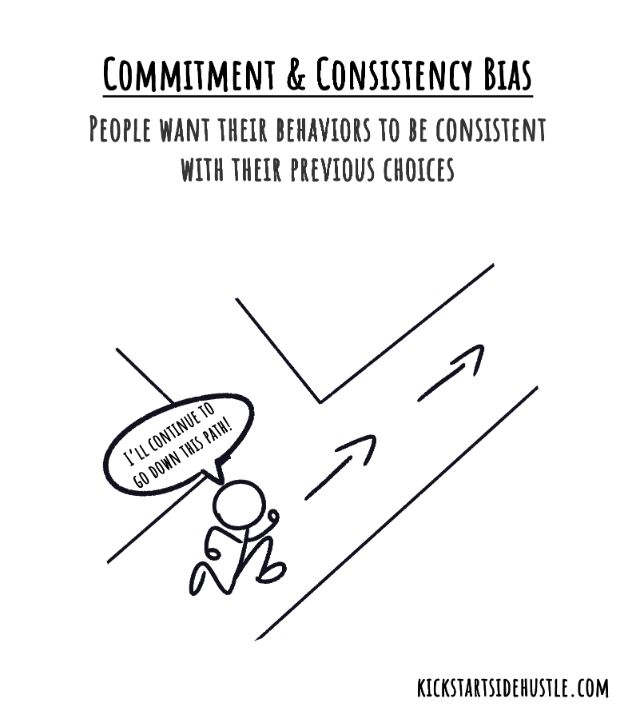
Commitment & Consistency Bias means once we commit to something, even in a small way, we feel the need to stay consistent with that choice. Changing course feels uncomfortable.
Think of agreeing to go to a Thursday 6 PM training session with a friend. After showing up once, you feel pushed to keep going every Thursday, not because the workout changed, but because you already committed to that specific slot and want to stay consistent with it.
In marketing this bias powers small onboarding steps, micro-commitments, quizzes, and simple one-click starts. Once people take the first step, they naturally follow through.
Commitment & ConsistencyGuide
Commitment & ConsistencyResearch
In the study from 1966, the researchers asked women to do a small favor - answer a few questions about the cleaning products they used. It was an easy, non-invasive request.
Three days later, the same women received a much bigger request - they were asked to let researchers into their homes for about 2 hours to check all their household products.
The result:
This well-known example, often mentioned by Robert Cialdini, tested how a tiny change in wording could reduce restaurant no-shows.
That small shift, from giving an instruction to getting a simple verbal promise, cut no-shows from 30% to 10%. It showed how even a tiny commitment makes people much more likely to follow through.
Commitment & ConsistencyExamples

1. Audible
Audible forces you to pick your first audiobook the moment you join. Once you choose a book, you psychologically commit to listening. This simple step massively boosts first-month retention.

When you click “Save for later,” Amazon treats this as a micro-commitment. You feel like you’ve chosen the item mentally, so buying it later feels consistent with your previous decision. This is why Amazon keeps those items visible forever - you already committed once.
IKEA Effect Details
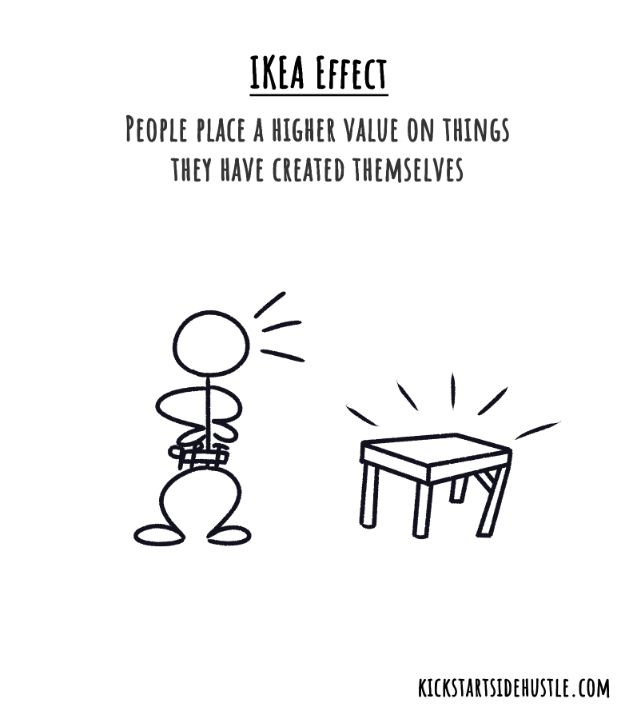
IKEA Effect means we value things more when we’ve put effort into making them, even if the final result isn’t perfect. Effort creates attachment.
Think of assembling a simple shelf at home. It might look a bit crooked, but because you built it yourself, it feels more special and harder to throw away than a similar one bought pre-assembled.
In marketing this bias shows up in customization tools, build-your-own kits, quizzes, and products that let people co-create the final outcome. When customers invest effort, their perceived value goes up.
IKEA Effect Guide
IKEA EffectResearch
One research found that even if participants had built a simple IKEA storage box by themselves, they were willing to pay 63% more for it, compared to a group of people who only saw the fully built.
IKEA Effect Examples

1. Nike By You
Nike’s Nike By You lets customers design their sneakers: colors, materials, engraving. People value these shoes far more than regular ones, even if the quality is identical. The effort of customizing makes the final product feel premium and emotionally important - pure IKEA Effect.

Notion doesn’t give you a rigid structure, you build your own system: pages, databases, templates. People overvalue their messy, homemade setups because they made them. The more time someone spends constructing it, the harder switching apps becomes (huge retention effect).
Tesler’s Law Details
Tesler’s Law means every feature should be as simple as it can possibly be. There’s always a minimum level of complexity in a system, and the goal is to cut it down until only the essential part remains. When you simplify past that point, things actually get harder to use. The system loses clarity, hides important steps, and forces users to guess.
Think of modern AI design tools that try to make everything one-click simple. They hide all the detailed controls, so you can’t fine-tune what you actually want. The tool feels easy at first, but the moment you need precision, you’re stuck fixing the image later in more complex software. The real work didn’t disappear, it only showed up somewhere else.
In marketing and product design Tesler’s Law pushes teams to find the sweet spot. Reduce friction, remove clutter, and make actions smooth, but keep the pieces that matter for understanding and control.
Tesler’s Law Guide
Tesler’s Law Research
The study challenged the idea that “simple design is always best.” The author showed that for powerful, feature-heavy software, too much simplicity actually makes the product weaker and less useful. The design should aim for “negotiated complexity” - simplify the parts that slow users down, but keep complexity where it adds value.
If your audience is advanced or your tool is professional-grade, some complexity is not a bug, it’s necessary power.
Tesler’s Law Examples

1. Gmail
Gmail offers a clean, minimal interface for reading and writing mail, while hiding a lot of underlying complexity (spam filters, threading, syncing, encryption, server protocols), so users don’t need to understand or manage all that complexity.

1. ChatGPT & Midjourney
AI image tools like ChatGPT or Midjourney are still too simple. You can’t precisely edit one part, so the model often changes the whole picture. Because of that, people still need advanced tools like Photoshop to fix the details.
Miller’s Law Details
Miller’s Law says our working memory can only hold about 7 (plus or minus 2) items at once. When there’s more than that, the brain starts dropping things or ignoring them.
Think of trying to remember a long Wi-Fi password with 14 random characters. Your mind instantly breaks or forgets parts because it’s too much to hold in one go. But if the same password is grouped into small chunks, it suddenly feels easy.
In marketing this matters because people don’t process long lists, crowded menus, or overloaded screens. If you give them too many choices or details at once, they bounce.
Miller’s Law Guide
Miller’s Law Research
Psychologist George Miller found that the average person can hold about 7 items (plus or minus 2) in their working memory at once. This is why phone numbers were traditionally seven digits long.
In practice, most people max out processing around 7 bits of information. Skilled individuals might handle 9, while others manage only 5.
Miller’s Law Examples

1. Google search
Google shows you a search bar + a tiny set of results. Even the page layout follows Miller’s Law - you mainly see one column and about 5-7 visible results, not hundreds at once.

McDonald’s keeps the banners above the counter extremely simple. This fits perfectly into Miller’s Law. Customers can scan the whole board in seconds without feeling overwhelmed.
Pseudo-Set Framing Details
Pseudo-Set Framing means we get motivated when tasks feel like part of an incomplete set, even if the set is totally made up. Our brain hates leaving things unfinished.
Think of loyalty cards that start you off with a few stamps already filled. You suddenly feel closer to completing the set, so you push harder to finish it, even though the extra stamps were artificial.
In marketing this bias drives progress bars, starter points, checklists, and reward systems. When people see themselves as partway through a set, they’re more likely to keep going.
Pseudo-Set Framing Guide
Pseudo-Set Framing Research
Website 1
Website 2
Website 3
The HBS pseudo-set framing research was tested in the real world with the Canadian Red Cross during its 2016 holiday fundraising campaign.
Over 7,000 donors were randomly sent to one of three pages:
The effect was huge: 21% of people in the pseudo-set condition donated the entire six-item kit, compared to only 5% in the gift condition and 3% in the cash condition. That's roughly a 320% increase in full-completion behavior. Simply showing the items as a “set” made people far more likely to finish it.
Pseudo-Set Framing Examples

1. LinkedIn - Profile Strength Meter
LinkedIn breaks your profile into a set of 5-7 pieces (photo, headline, experience, skills, summary, connections, etc). These elements don’t actually need to be treated as a set, but framing them together with a progress bar creates urgency to complete the full set. This pseudo-set framing makes users finish their profiles far more often.

H&M dresses mannequins in a full outfit. Usually 5-7 items like a jacket, shirt, pants, shoes, and accessories. Even though each item is sold separately, the outfit looks like one complete set in your mind. Because of this, many shoppers try to buy the whole outfit, not just one piece.
Dunning-Kruger Effect Details
Dunning-Kruger Effect means people with low skill often feel more confident than they should. They don’t know enough to see what they’re missing, so their confidence rises while their ability stays low.
Think of someone who learns a tiny bit about a topic and suddenly feels like an expert, only to realize later how much they didn’t understand. The early confidence was based on a small view of the problem.
In marketing this effect shows up when teams make big assumptions with little data, or when new creators think success will be easy because they don’t see the hidden work. Awareness grows only after experience.
Dunning-Kruger Effect Guide
Dunning-Kruger Effect Research
The effect was first shown in 1999 by David Dunning and Justin Kruger. In their study, Cornell students who scored very low (about 12%) thought they scored much higher (about 62%). The top performers did the opposite, they slightly underestimated their results.
Dunning-Kruger Effect Examples

1. Duolingo
Duolingo leans on Dunning–Kruger in a smart, gentle way. Early in the app, it makes you feel better and more capable than you really are. Quick wins, easy exercises, green checkmarks, “Great job!” screens. That early overconfidence keeps newbies motivated instead of quitting in week one.
Only later, when you’re already hooked, the difficulty slowly rises and you realize how much you still don’t know.
Fyre Festival sold a fantasy they could never build. Slick ads with supermodels and private-jet vibes made people believe it would be the ultimate VIP island event.
Behind the scenes, they had no logistics, no housing, no artists confirmed, basically nothing ready. When guests arrived, they got disaster-relief tents, cold cheese sandwiches, and chaos instead of luxury. It became one of the biggest expectations vs reality failures ever.
Decision Fatigue Details
Decision Fatigue means the more choices we make, the worse our decisions get. Our mental energy drains with every choice, and by the end we pick whatever is easiest, not whatever is best.
Think of grocery shopping at the end of a long day and grabbing random snacks at the checkout, you didn’t plan to buy. Your brain is tired, so it goes for the simplest option.
In marketing decision fatigue shows why fewer options, clear paths, and simple choices convert better. When people feel mentally tired, they choose the easiest button, plan, or don't buy at all.
Decision Fatigue Guide
Decision Fatigue Research
Researchers took a closer look at parole decisions made by experienced judges. It turned out that it was much more likely for the prisoner to be granted parole depending on the time of the day.
65% of positive decisions were made in the morning, when you're fresh, and fell dramatically later on. The rate returned to 65% after a lunch break and then fell again.
The jam experiment from 2000 proved that when there are too many choices we avoid making decisions to prevent making a bad one.
On the first day, people in a store were given 24 types of jam to choose from. On the second day, they were only given six. The group with fewer choices was 10 times more likely to buy something. This is because having lots of choices can make it hard to decide, so people choose not to decide at all.
Decision Fatigue Examples

1. Trader Joe’s
Trader Joe’s keeps things simple on purpose. Instead of giving you 20 types of ketchup, they give you maybe 2.

Flow State Details
Flow State means you’re so focused on a task that everything else fades away. Time moves fast, distractions disappear, and the work feels smooth and almost automatic.
Think of playing a game, drawing, or coding and suddenly realizing an hour passed without you noticing. You were fully inside the activity, not thinking about anything else.
In marketing and product design flow keeps people engaged for long periods of time. Clear goals, quick feedback, and tasks that are challenging but not overwhelming pull users deeper into the experience.
The right balance of focus and challenge makes the world fall away.
Flow State Guide
Flow State Research
A study with 400 online shoppers found that clean layout, nice visuals, small animations, and social presence all boosted the flow score to 4.10/5. One element (virtual atmospherics - the mood created by visuals, colors, animations, sounds, and micro-interactions) had a significant effect on flow. When the flow went up, purchase intention also went up significantly.
A study with 310 mobile-shopping users found that when an app is easy to use and clearly helpful, people enter flow. That flow then increases how much they like the app and how willing they are to buy.
Usefulness by itself didn’t change attitudes. It only worked through flow, meaning the full path was: useful + easy >> flow >> better attitude >> stronger purchase intention.
Flow showed a strong, meaningful effect on both attitude and buying, though the study didn’t report simple percentage changes. The core insight is that mobile shopping apps should feel effortless and genuinely helpful, because this creates flow, and flow is what makes people want to buy.
Flow State Examples

1. Duolingo
Duolingo keeps people in flow because every lesson is short, clear, and gets a bit harder each time. You always know what to do next. Instant feedback (green check, exp, streak, sounds) keeps your brain locked in. No big decisions, no friction. Users often do 10–30 minutes without noticing.

Sounds weird, but Trader Joe’s stores are engineered for flow. Small aisles, simple layouts, limited choices = no overload. Everything is clearly labeled and consistent, so shopping becomes automatic. Samples, colors, smells, and handwritten signs add micro-feedback and micro-discoveries. People get into a rhythm and finish shopping faster without feeling rushed.
Cognitive Dissonance Details
Cognitive Dissonance means we feel uncomfortable when we hold two conflicting beliefs or our actions and beliefs don’t match. The mind hates this tension and tries to reduce it fast.
Think of someone who buys an expensive product they don’t really need. To ease the discomfort, they start convincing themselves it was a smart decision, even if it wasn’t. The story changes to fit the action.
In marketing this effect shows why people justify purchases, ignore flaws, or defend brands they’ve already chosen. Once they commit, they shape their beliefs to feel consistent.
Cognitive Dissonance Guide
Cognitive Dissonance Research
Classic studies showed that after making a choice, people often increase their positive feelings for the chosen option and diminish their liking for the option they rejected.
In one study, shoppers were asked to rank household items and then choose one to keep. Later, they ranked the items again - and lo and behold, the item they chose climbed higher in attractiveness while the one they passed up fell in their ratings.
Lipponen looked at many older studies to see what people do when they feel unsure after buying something. The research he reviewed showed the same pattern: after a purchase, people try to remove the uncomfortable feeling by:
The final result is that customers use predictable, repeated behaviours to calm down their “did I choose right?” feeling.
Cognitive Dissonance Examples

1. Amazon reviews
After buying something online, people often feel a small worry that they may have picked the wrong product. Amazon reduces this discomfort by showing tons of reviews, star ratings, customer photos, Q&A sections, and the Amazon’s Choice badge.
Seeing that many other people bought and liked the item calms the brain and removes that uneasy feeling after purchasing.
Confirmation Bias Details
Confirmation Bias means we pay more attention to information that supports what we already believe and ignore anything that challenges it. Our brain prefers comfort over correction.
Think of someone who loves a brand and only notices positive reviews while brushing off the negative ones. They’re not seeing the whole picture, just the parts that fit their belief.
In marketing this bias shapes how people read ads, reviews, and claims. If your message aligns with what they already think or want, they accept it quickly. If it clashes, they tune it out.
In other words, we look for proof that we’re already right.
Confirmation Bias Guide
Confirmation BiasResearch
In a classic confirmation bias experiment, people who strongly supported or opposed the death penalty were shown two studies:
Instead of becoming more open-minded, each group became even more convinced they were right. Supporters praised the study that backed their view and tore apart the one that didn’t. Opponents did the exact same in reverse. Everyone rated the study that matched their belief as “strong” and the other as “weak.”
In the end, both sides became more polarized, proving we naturally look for info that confirms what we already believe and attack anything that challenges it.
Confirmation Bias Examples

1. New Coke
Coke tried to replace its classic formula in 1985 after blind tests said people liked the sweeter New Coke more. But loyal Coke fans already knew the original was the best. Confirmation bias kicked in hard. They rejected the new flavor, hunted for reasons it was bad, and organized protests. Taste didn’t matter, their belief did. Within months, Coke was forced to bring back the original.

Shopify fills its homepage with success stories of brands that scaled using Shopify.
If you come in already thinking “Shopify is good for growth,” these stories confirm it.
Your brain sees only evidence that matches your belief.
Doubts go down, trust goes up, conversion goes up.