Behavioral economics & viral marketing case studies


Features to Benefits Details
Features to Benefits means people care less about what a product has and more about what it does for them. A feature is technical, a benefit is how that feature improves someone’s life.
Think of a blender advertised as having “1200 watts.” Most people don’t know what that means. But say “blends smoothies in 10 seconds,” and suddenly it clicks.
In marketing this shift shapes product pages, ads, emails, and demos. Explaining benefits helps people imagine the outcome, not the mechanics, which makes decisions much easier.
Features to Benefits Guide
Features to Benefits Research

Old launcher

D - Free town
EA ran a controlled A/B experiment inside The Sims 3 game launcher to understand whether feature-oriented messaging or benefit-oriented messaging would drive more players to register their game.
The control (old launcher) was the standard launcher screen that showed many competing messages, generic registration benefits, and unclear reasons to sign up. Registrations from this control were low.
EA then tested 6 new variants, each representing a different style of messaging:
Every tested variant outperformed the old launcher, with lifts of +43% or more.
But the biggest finding was the gap between features and benefits:
All feature-style variants (A1, A2, B) performed worse than any specific-benefit variant.
Features to Benefits Examples

1. Apple
Feature: 5GB of storage.
Benefit: 1,000 songs in your pocket.
Apple didn’t sell storage. They sold a lifestyle upgrade in one sentence.

Feature: Organized channels, file sharing, app integrations.
Benefits: Slack users experience 48,6% fewer emails since they started using the platform.
Slack sells relief from overwhelm, not software tools.
Bandwagon Effect Details
Bandwagon Effect means we’re more likely to choose something when we see many others choosing it. Popularity acts like proof.
Think of hearing that everyone is watching a new show. Even if you weren’t interested before, you feel a pull to check it out, partly to fit in, partly to not feel left out.
In marketing this bias powers social proof, bestseller tags, reviews, waitlists, and visible community numbers. When people see a crowd, they assume the choice is safe and worth joining.
Bandwagon Effect Guide
Bandwagon EffectResearch
The study examined the bandwagon effect in luxury buying. It focused on how much people want a luxury product when they believe popular or high-status people already use it.
The researcher ran 3 experiments with 60 teenagers, 76 female students, and 73 male students/graduates.
When people saw a message saying “popular people use this product,” several things changed:
The study clearly showed that the bandwagon effect works: when a product is linked to an admired group, people want it more, pay more, and choose options that signal status.
Cialdini’s famous hotel-towel study showed that people follow the bandwagon effect.
Guests saw 3 messages:
Message #2 increased towel reuse by 26%, and the message #3 increased it by 33%, making it the most effective. The study proved that people follow what others do, especially when the group feels close or similar to them.
Bandwagon Effect Examples

1. Clubhouse
When Clubhouse launched, people rushed in not because they needed audio chats, but because thousands of others were already inside. The invite-only system made it feel like a growing party you didn’t want to miss. The Bandwagon Effect created explosive growth to 10M weekly users before the hype faded.

Game of Thrones became a cultural event partly because huge numbers of people were already talking about it - memes, spoilers, theories, and reactions filled the internet every week. Even people who normally don’t watch fantasy felt pressure to join in, just to understand conversations at work or avoid feeling left out. The Bandwagon Effect turned the show from a niche book adaptation into one of the biggest global TV phenomena, reaching over 19M viewers for the finale.

TBH grew insanely fast because its viral loop was engineered to spread inside one school at a time, not across a whole city or country. When the app launched in a new school, hundreds of students got the same notifications, polls, and compliments at once, creating the feeling that “everyone here is using it.”
This hyper-local explosion triggered a powerful Bandwagon Effect. Once a few classmates joined, the whole school rushed in, because no one wanted to be the only person not included.
TBH hit millions of downloads in weeks, not because the app was global, but because each school became its own viral ecosystem driven by social pressure and FOMO.
Framing Effect Details
Framing Effect means the way information is presented changes how we feel about it, even when the facts stay the same. The frame shapes the reaction.
Think of hearing that a product is 90% effective versus hearing it has a 10% failure rate. Same numbers, but one feels safe while the other feels risky. The wording sets the mood.
In marketing, highlighting gains feels motivating, highlighting losses feels urgent, and shifting perspective can make the same offer look far more attractive.
Framing Effect Guide
Framing Effect Research
People were told a disease would kill 600 people. They had to choose between two programs.
The options were identical, only the wording changed.
1. Gain frame (positive)
Results:
2. Loss Frame (negative)
Results:
Same math. Different frame. Completely different behavior.
Framing Effect Examples

1. BetterHelp
Betterhelp therapy reframes therapy as normal self-care. The homepage frames depression as something normal. This reduces stigma and makes the purchase feel proactive, not reactive.

Liquid Death framed water as rebellious “Murder Your Thirst” beverage. They took a boring product (water) and reframed it as a punk, metal, anti-plastic energy-drink vibe.
Law Of Proximity Details
Law of Proximity means we see things that are close together as belonging together. Our brains group nearby elements automatically, even if they’re not actually connected.
Think of looking at a row of icons on your screen. If two icons sit close to each other, you assume they’re related or part of the same category. Distance changes the meaning.
In marketing and design this law shapes how people read layouts, menus, and messages. Putting elements close together makes them feel linked, while spacing them out separates ideas and reduces confusion.
Law Of Proximity Guide
Law Of Proximity Research
A study showed that people who strongly react to the Law of Proximity in vision tasks are also more likely to show the attraction effect when choosing products.
In 2 experiments (100+ participants), people who grouped nearby shapes more strongly were also more likely to choose the option that sat “closest” to similar alternatives in a choice set, meaning proximity in layout makes one option feel naturally more attractive. This means product cards, pricing plans, or features placed close together can steer users toward the grouped option.
Law Of Proximity Examples

1. Trello
Trello keeps related things close together. Cards stay in one list, and lists stay together on a board. Because they sit side by side, your brain reads them as one unit. This makes the whole project feel easier to understand and manage.

HubSpot’s CRM uses proximity by keeping every key customer detail (notes, emails, deals, tasks) tightly grouped in one clean panel, so your brain instantly reads it as one story instead of scattered data.

Coca-Cola used the Law of Proximity to kill Crystal Pepsi. They launched Tab Clear, a cheap look-alike positioned as a diet soda, and placed it right next to Crystal Pepsi so shoppers would mentally link the two.
Because diet sodas were seen as weak and inferior, Crystal Pepsi instantly lost its “healthy mainstream” positioning, and the whole clear-cola idea collapsed.
Within 18 months, both products were dead, and Coca-Cola successfully destroyed the entire category with a deliberate sabotage strategy.
Curiosity Gap Details
Curiosity Gap means we feel a strong pull to fill in missing information. When we see a hint without the full answer, our brain wants to close the gap.
Think of reading a headline that teases a surprising fact but doesn’t give the full story. You click because the missing piece bothers you just enough to take action.
In marketing this gap drives engagement. Teasers, questions, partial reveals, and open loops make people lean in because they want to know what comes next.
Curiosity Gap Guide
Curiosity Gap Research
In a study from 2007, people chose between a sure thing (cash) and a mystery prize. When the researchers gave them just a little information about the mystery box (not the whole truth), curiosity shot up. People became more than twice as likely to choose the unknown prize instead of the cash. That small tease created a curiosity gap, and the urge to learn the missing info pushed them to take the risk.
A large analysis of 8,977 headline A/B tests found that headlines with an optimal “curiosity gap” achieved the highest CTR.
Upworthy’s data showed that only ~9% of very vague headlines gained clicks by adding info, whereas over 50% of overly detailed headlines actually saw ~5–10% fewer clicks.
This supports Loewenstein’s information-gap theory: headlines that leave readers guessing (not too little, not too much) can boost engagement.
Research on email marketing showed that using curiosity gap can lift open rates. In one study, 33% of recipients opened an email solely due to a compelling, curiosity-inducing subject line. Adding personalization further amplified this effect - personalized, curiosity-gap subject lines saw open rates climb by ~35%.
Curiosity Gap Examples

Ogilvy put a cheap eye-patch on a perfectly normal model wearing Hathaway shirts. This made people instantly curious about the model.
The first ad ran in The New Yorker in 1951. Within a week, every Hathaway shirt in New York was sold out.


In 2004, Heyah flooded cities with a strange red hand logo and a website called “nadchodzi.pl” (“it’s coming”) - but didn’t reveal the brand.
People kept asking “What is this? Who is behind it?” The curiosity gap exploded, driving 1.2M unique visitors before launch.
When the reveal finally came, Heyah got over 300k users within the first month.
Familiarity Bias Details
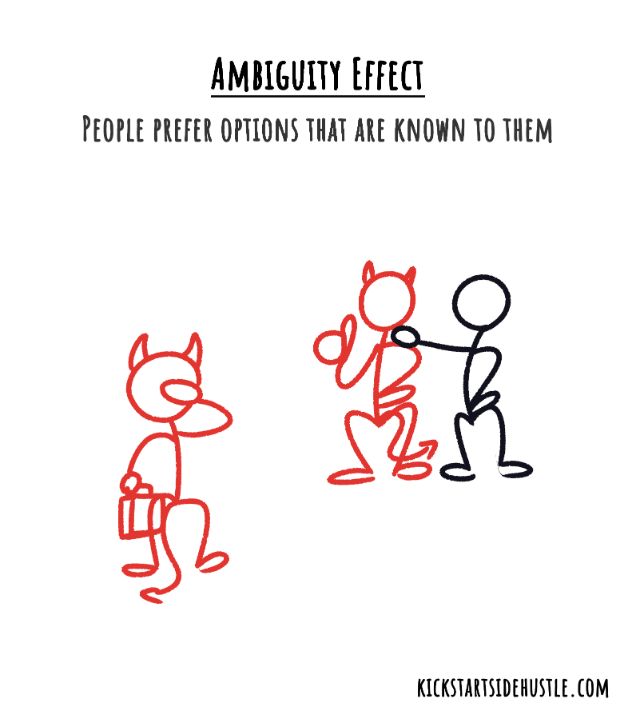
Familiarity Bias means we trust and prefer things we already know. Familiar options feel safer, easier, and less risky than new ones, even if the new ones might be better.
Think of choosing a brand you’ve bought for years instead of trying a new one with better reviews. The comfort of the known beats the potential of the unknown.
In marketing this bias rewards consistency. Repeated exposure, steady branding, and showing up often make your product feel familiar, and familiarity drives choice.
In other words, we pick what feels known, not always what’s best.
Familiarity Bias Guide
Familiarity Bias Research
The study tested how being familiar with a brand, having previous online-shopping experience, and the amount of product information shown on a website, influence how risky people think online shopping is and whether they intend to buy.
The results:
Familiar brands and previous online shopping experience significantly reduced perceived risk and increased purchase intention. However, surprisingly, the amount of product information provided (lots vs little) did not significantly affect perceived risk or purchase intention.
Familiarity Bias Examples

1. Trello
Trello exploded because it took the Kanban board, a format millions already knew from offices, factories, and whiteboards, and turned it into super simple drag-and-drop software.

GPT-3 was powerful, but almost nobody used it because the interface felt technical and abstract. When OpenAI released ChatGPT with a simple chat-style UI, something everyone already knew from Messenger/WhatsApp, usage exploded within days.

Among Us blew up because its core gameplay was basically the digital version of Mafia/Werewolf/Secret Hitler - games millions already knew from parties.
Halo Effect Details
Halo Effect means we judge a person or a thing based on one strong trait. That single trait (good or bad) shapes our whole impression, especially during the first experience.
Think of meeting someone who’s kind right away. You instantly assume they’re also trustworthy and reliable. The same works in reverse, one rude moment can make everything else about them feel worse. The first trait sets the tone.
In marketing, a great first interaction, a beautiful design, or an excellent product lifts the entire brand. A bad first moment can drag everything down.
Halo Effect Guide
Halo Effect Research
In 1920, psychologist Edward Thorndike studied how officers rated their soldiers on things like leadership, appearance, intelligence, and loyalty. He found that if a soldier looked good in one area, officers automatically gave them high scores in the other areas too.
Later research found one big reason: attractiveness. Good-looking people are often seen as smarter, kinder, and better overall. Jurors are even less likely to think attractive people are guilty. But it can backfire. Other studies show people also think attractive people are more vain, less honest, and more likely to use their looks to get what they want.
Halo Effect Examples

1. Red Bull - extreme sports
Red Bull sponsored extreme sports, and that cool, high-adrenaline world created a halo around the drink. People felt the product itself was more energizing because of its associations. The drink became a lifestyle symbol, not just a beverage.

Patagonia consistently invests in pro-planet actions — repairs, recycling, “Don’t Buy This Jacket,” activism, and giving profits to environmental causes.
This moral reputation creates a halo: people believe all Patagonia products must be high-quality, fair, sustainable, and worth paying extra for.
Customers reward the brand with loyalty and higher willingness to pay, even without comparing specs.
Miller’s Law Details
Miller’s Law says our working memory can only hold about 7 (plus or minus 2) items at once. When there’s more than that, the brain starts dropping things or ignoring them.
Think of trying to remember a long Wi-Fi password with 14 random characters. Your mind instantly breaks or forgets parts because it’s too much to hold in one go. But if the same password is grouped into small chunks, it suddenly feels easy.
In marketing this matters because people don’t process long lists, crowded menus, or overloaded screens. If you give them too many choices or details at once, they bounce.
Miller’s Law Guide
Miller’s Law Research
Psychologist George Miller found that the average person can hold about 7 items (plus or minus 2) in their working memory at once. This is why phone numbers were traditionally seven digits long.
In practice, most people max out processing around 7 bits of information. Skilled individuals might handle 9, while others manage only 5.
Miller’s Law Examples

1. Google search
Google shows you a search bar + a tiny set of results. Even the page layout follows Miller’s Law - you mainly see one column and about 5-7 visible results, not hundreds at once.

McDonald’s keeps the banners above the counter extremely simple. This fits perfectly into Miller’s Law. Customers can scan the whole board in seconds without feeling overwhelmed.
Authority Biasy Details
Authority Bias means we’re more likely to believe, follow, or buy from someone who looks like an expert. Titles, uniforms, credentials, or even confident language make our brain trust faster.
Think of how people take medical advice more seriously when someone wears a white coat, even if they say the exact same words without it. The symbol of authority flips a switch in our mind.
In marketing this bias shapes how brands use testimonials, expert endorsements, certifications, and professional visuals. When something feels official, people stop questioning and start agreeing.
Authority Bias Guide
Authority Bias Research
In the authority/ obedience experiment run by Stanley Milgram, a volunteer participant was told they were helping with a study on learning and memory at Yale University. Another man played the role of the “learner,” but he was an actor working with the researchers. The role assignment was rigged so the real volunteer was always the participant who delivered the shocks.
The participant sat in front of a shock generator with 30 switches, ranging from 15 volts to 450 volts, increasing in steps of 15 volts. The switches were labeled with warnings such as “Slight Shock,” “Strong Shock,” and “Danger: Severe Shock.” The last two switches were labeled “XXX” - extreme danger.
Each time the learner (actor) gave a wrong answer, the participant was instructed to press the next switch and increase the voltage. The shocks were not real, but the participant believed they were.
As the voltage increased, the learner (actor) reacted with pain sounds, protests, and screams. He said he had a heart condition and demanded to stop. At 300 volts, he banged on the wall. After about 330 volts, he stopped responding completely. Many participants showed visible distress and wanted to quit. When they hesitated, a calm experimenter wearing a lab coat used standardized prompts such as “please continue” and “the experiment requires that you continue.”
Results of the original experiment:
Before the experiment, psychiatrists predicted that 0.1% of people would go to the maximum voltage.
Milgram ran many versions. Obedience was measured as the percentage who went to 450 volts.
A group of real estate agencies tested a tiny change based on authority. When customers called, the receptionists didn’t just transfer them. They first mentioned the agent’s expertise:
Nothing else changed, just a quick credibility boost before the call.
That small introduction worked surprisingly well. Appointments went up by about 20%, and signed contracts rose by around 15%. Simply hearing an expert’s credentials made people trust the conversation more and take action.
Authority Bias Examples

1. Frozen Farmer - “As Seen on Shark Tank”
Frozen Farmer puts “As Seen on Shark Tank” everywhere. The Shark Tank authority makes people instantly trust the brand, even if they’ve never heard of it before.

Peloton use real certified trainers leading workouts on-screen. Because the leaders are professionals, users feel the workouts are safe, effective, and legitimate. The authority of experts creates emotional trust and higher willingness to buy an expensive bike.
Law of Similarity Details
Law of Similarity means our brain naturally groups things that look alike. When objects share color, shape, size, or style, we treat them as belonging together, even if they aren’t.
Think of seeing a shelf full of products where a few items use the same bright color. Your eyes automatically pair them and assume they’re part of a set or the same brand, even before reading any label.
In marketing this bias shapes how brands design packaging, product lines, and website elements. When similar things look unified, people find them easier to understand and navigate.
Law of Similarity Guide
Law of Similarity Research
The study tested whether the Law of Similarity can make our visual working memory (VWM) work better. Earlier research shows that VWM usually stores only about 4 items, so the question was, can similarity help us hold more?
Overall, the research shows that the Law of Similarity helps memory by letting the brain “chunk” similar items into one group, but this only works when the items are visually close to each other. If they are too far apart, the brain does not group them, and the benefit is lost.
Law of Similarity Examples

1. Supermarket packaging copies
Many private-label brands intentionally design their packaging to look almost identical to the leading brand - same color layout, same typography rhythm, same imagery. Shoppers think “looks like the one I know so it must be good.” These lookalike designs often boost sales massively because:

Coca-Cola used the Law of Similarity to kill Crystal Pepsi. They launched Tab Clear, a cheap look-alike positioned as a diet soda, and placed it right next to Crystal Pepsi so shoppers would mentally link the two.
Because diet sodas were seen as weak and inferior, Crystal Pepsi instantly lost its “healthy mainstream” positioning and the whole clear-cola idea collapsed.
Within 18 months, both products were dead, and Coca-Cola successfully destroyed the entire category with a deliberate sabotage strategy.