

Dupe.com – How to Grow Your Web App to 2M Users in 3 Months (8 min read)
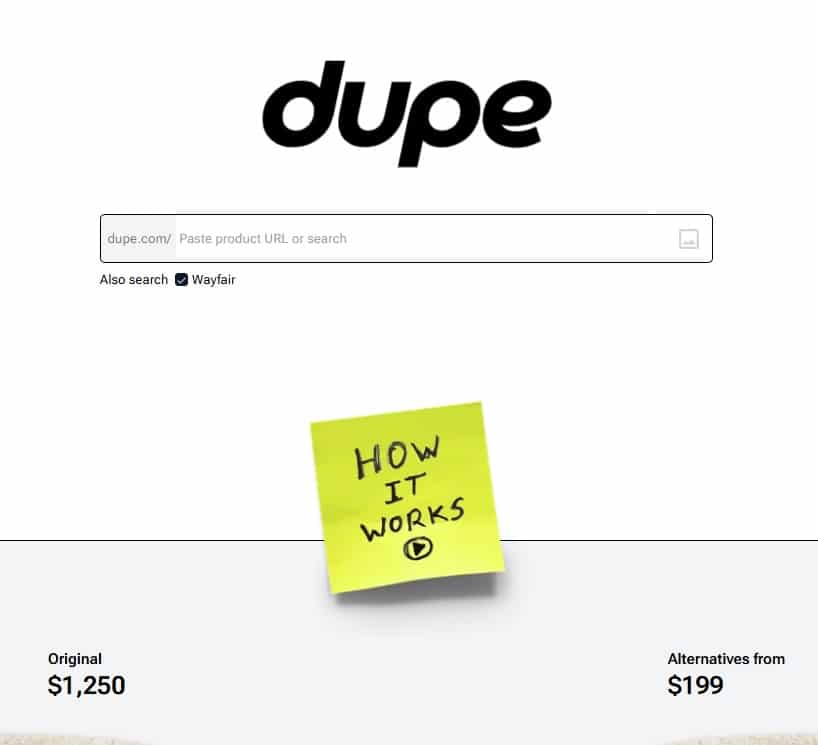
Dupe - founded by Bobby Ghoshal, Dupe.com is a website helping users find affordable furniture options similar to high-end pieces. The website itself features only a URL input field. Users can enter a URL of an expensive furniture item, and Dupe will locate similar, more affordable versions available on popular retail sites such as Amazon, Wayfair, and Ikea.
tl;dr - Dupe.com story in 30 seconds or less
- Bobby Ghoshal created the Carrot web app, but after 3 years, their business was stuck and was making barely any money
- Nikita Bier hopped in as a consultant and helped them rebrand to Dupe.com by niching their platform down to a single feature
- After rebrand, and promo by Nikita, Dupe.com relied solely on short-form content that helped them achieve profitability within 8 weeks, and 2M users within 3 months
 Strategy & Tools
From Carrot to Dupe
Dupe started off as a different product called Carrot, an AI shopping assistant. After 3 years and gaining 250k users, the team realized Carrot wasn’t making enough money, so they knew it was time for a change.
They brought on Nikita Bier (the guy who created the tbh app) as a consultant. Nikita had really just 1 job - to find anything in this product that is redeemable. A week later, they have identified Carrot’s standout feature, “Deal Hop,” an AI deal-finder that was super popular and the main reason people signed up for Carrot.
Bobby decided to go all in—he bought the dupe.com domain and rebranded Carrot around this one powerful feature.
Removing friction - Zero time to value
Dupe’s main strength is its instant value. Unlike Carrot, which made people jump through hoops:
- Install an app
- Sign up for an account
- Go through onboarding
- Set up the Safari extension
- Remember to use the app while shopping
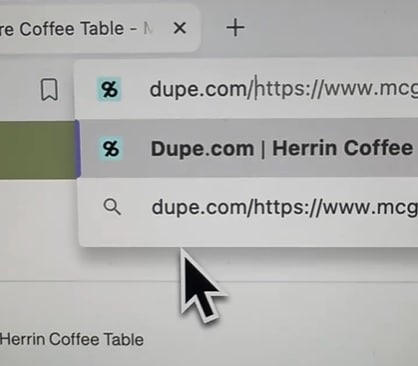
After some advice from Nikita, they redesigned it so users get value instantly. Dupe is all about simplicity. Now, you just paste the furniture URL directly on dupe.com, or add "dupe.com/" before the product URL—no setup, no extra steps. It delivers what they call “zero time to value,” which really changes the experience.
First virality
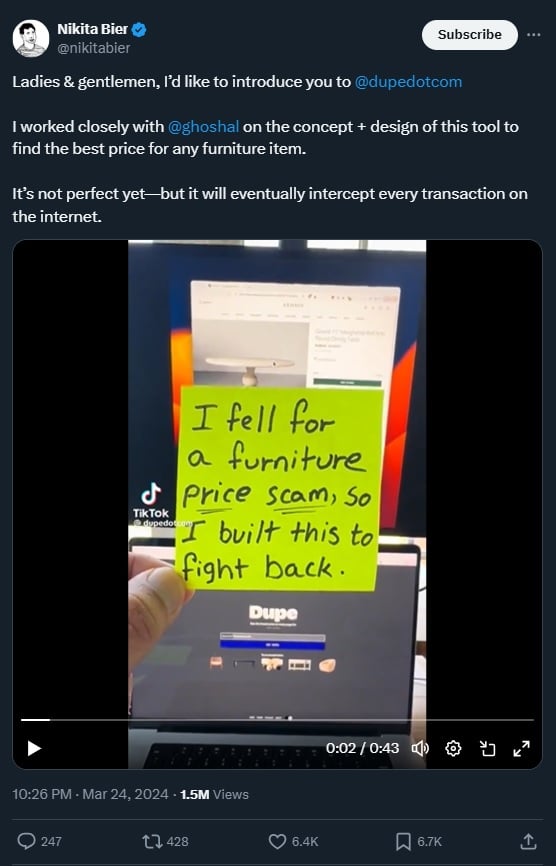
After the rebrand was done, Nikita offered Bobby to share Dupe.com on his Twitter account. He took Bobby's best TikTok video with posting notes and shared it on his profile.
That's what Bobby said about it:
I shit you not, Jason, my phone did not stop vibrating for 48 hours. I lost it; I was like, "This is crazy! The growth here is insane; everyone is talking about it, people are excited about it." I was expecting a lot more pushback from people, but no one pushed back. Everyone was really into it, and it looks like Nikita made that happen—he injected the first dose of virality into the product.
Short-form video
After the initial virality and a massive traffic spike, 2 days later, there was a big drop. There was no network effects, Dupe it’s a single-player model. On the bright side, the tech world had learned they existed.
Instead of relying on traditional ad strategies, they focused on short-form, shareable content that could go viral on platforms like Instagram Reels and TikTok. To expand reach, they've set up multiple TikTok accounts in the same tone but targeting different audiences. A key insight was tracking the send-to-like ratio, which showed high engagement and helped them refine what resonated most.
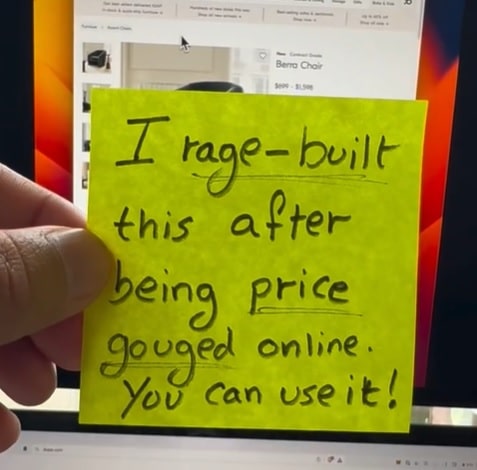
The first breakthrough? Sticky notes. Bobby started with simple Post-its, using different phrases to find what clicked, and some ended up pulling in millions of views.
Dupe's approach was “spicy”, bold and memorable. Audiences want content with character, so they went with the “hot or cold milk” approach.
Repetition
Inspired by the marketing legend, Rosser Reeves, Bobby implemented the repetition strategy in their videos - "in a 30-second ad, mention the product name 3 times to help with recall". In almost every video, he'd mentioned "go to dupe.com D-u-p-e.com" and it caught on. People and even major platforms like the Today Show even echoed their messaging style.
Main content formats:
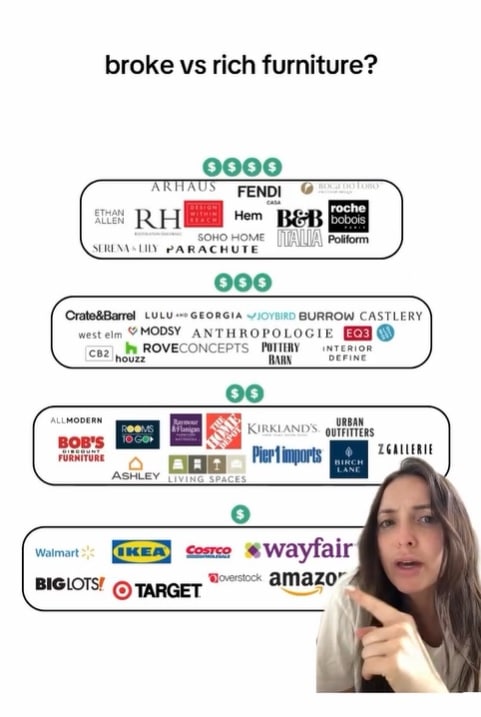
- Rich vs. broke furniture chart - showcases “broke” to “rich” furniture, appealing to those after a luxury look without the price tag.
- Green screen demo - a “Pinterest hack” reveal through green screen, piquing curiosity.
- Post-it note hook - Simple Post-It hooks grab attention fast, no overlays needed.
Hooks:
- Humor
- “Your couch is why you aren’t getting laid,”
- Life lesson: don’t mess with nerds. I fell for a scam and this is how I'm fighting back " - Relatability
- Look at this affordable alternative to expensive designer furniture
- My interior designer just showed me this…
- I accidentally showed the world this Pinterest hack
- I fell for a furniture price scam - Curiosity
All of them aroused curiosity among viewers.
They kept viewers engaged with multiple hooks and a fast pace, all while maintaining a friendly, genuine tone that makes people feel part of an insider community. It’s was all about genuine advice over a hard sell, building trust and making the content share-worthy.
This approach has paid off. In 2 months they've got:
- 32M views
- 530,000 likes
- 735,000 shares
Monetization
Dupe is building towards creating the world’s first hybridized marketplace, offering products directly while also making commission on affiliate links for items bought elsewhere. The ultimate goal is a marketplace where users find the best deals, whether they buy from Dupe or another source.
 Psychology
Law of the Least Effort
Dupe made it simple. You just paste a furniture URL or add "dupe.com/" before it. No sign-ups, no extensions, no hoops to jump through. People like the easy path. By trimming the steps, Dupe tapped into our natural urge to avoid hassle. Less effort meant more users.
The Mere Exposure Effect
"Go to dupe.com. D-U-P-E dot com." Bobby said it 3 times in nearly every video. The name stuck because he repeated it. Over and over. It became familiar, hard to forget. Repetition made Dupe memorable.
Humor Effect
Lines like "Your couch is why you aren’t getting laid" grabbed attention. They made people laugh. Humor broke down walls. It drew folks in and kept them watching. A good joke made the message shareable. People love to pass on a laugh.
Relatability
In videos, they spoke to the everyday person: "Look at this affordable alternative to expensive designer furniture." Viewers saw themselves. They wanted style without the steep price. By sharing common desires, he built trust. It felt like advice from a friend.
Authority Bias
When Nikita Bier shared Dupe's content, it mattered. He's a name people respect. His nod gave Dupe credibility. Followers paid attention because Nikita vouched for it. Teaming up with known figures made Dupe seem legit.
Curiosity Gap
Teasers like "I accidentally showed the world this Pinterest hack" piqued interest. People wanted to know the secret. Unanswered questions pulled them in. They watched the whole video to satisfy that itch. Curiosity kept them hooked.
 Window of Opportunity
Businesses often wrestle with growth. It’s daunting, sure, but there’s a silver lining if you look close enough.
- Work with a seasoned hand who’s been through it all. Cut out the endless trial and error.
- Use a "zero time-to-value" approach, and make it easy as hell for your customers to get on board.
- Find the right channel for your business. If you’re B2C, short-form videos might be the winning strategy for you these days.
- Build a simple, repeatable way to market-then run it, and run it well.