

Crystal Pepsi – How Coca-Cola Kamikazed Its Own Product To Destroy a Billion-Dollar Pepsi Brand (12 min read)
Crystal Pepsi was a caffeine-free, clear cola launched by Pepsi in 1992, marketed as a pure and healthier alternative to regular soda. They hyped it as the “clean” and futuristic drink during the whole clear-craze trend. Despite a strong launch and $474M in first-year sales, it quickly faded due to consumer confusion and a clever sabotage campaign by Coca-Cola.
tl;dr - Crystal Pepsi story in 30 seconds or less
In 1992, PepsiCo launched Crystal Pepsi, a clear cola meant to symbolize purity and health.
It became one of the most successful new product launches in soft drink history, making $470M in its first year.
Coca-Cola, instead of competing directly, introduced Tab Clear - a deliberate sabotage product.
Tab Clear confused consumers by mimicking Crystal Pepsi but being sugar-free and diet-branded.
By 1994, both products were dead. Coca-Cola had killed the clear cola category by design.
 Strategy & Tools
Crystal Pepsi History Timeline
- Late 1980s–Early 1990s - The “clear craze” marketing fad takes off. Clear products are linked to purity, health, and the future.
- Early 1992 - Pepsi begins developing a clear cola to ride the trend. Over 3,000 formulas are tested.
- April 1992 - Crystal Pepsi launches in test markets: Dallas, Providence, Salt Lake City, and Colorado. Demand spikes quickly.
- Late 1992 - Coca-Cola develops Tab Clear as a decoy to sabotage the clear cola category.
- December 14, 1992 - Crystal Pepsi rolls out nationwide. Pepsi sees it as a billion-dollar brand.
- December 14, 1992 - Coke launches Tab Clear in 10 major US cities on the same day Crystal Pepsi goes national.
- January 31, 1993 - Pepsi runs a $7–10M Super Bowl ad for Crystal Pepsi.
- January–March 1993 - Coke expands Tab Clear to the UK and Japan.
- Mid 1993 - Tab Clear is quietly pulled.
- 1993–1994 - Crystal Pepsi’s taste draws criticism. Consumers are confused by the health positioning.
- 1994 - Pepsi releases “Crystal from Pepsi,” a citrus-flavored reboot. It fails.
- Mid–Late 1994 - Both Crystal Pepsi and Tab Clear are discontinued.


The Clear Craze from the 1980s and 1990s was everywhere. Source
The "Clear Craze"
In the late 1980s and early 1990s, the clear craze FAD swept across categories like soap, beer, electronics, and even soft drinks. Clarity (colorless) was marketed as purity, health, and a better future. Sparked by Ivory soap's "99.44% pure" campaign, brands rode the wave of transparent everything.

PepsiCo wanted in. Its CEO for North America, Craig Weatherup, was trying to position Pepsi as a "total beverage company" and expand beyond traditional cola. Competitors like Clearly Canadian with theirs Nordic Mist and Snapple were thriving in the New Age beverage category, and soft drink sales were starting to slow.
Meanwhile, Coca-Cola had some early history with clear cola too, a secret political favor during WWII produced a vodka-disguised "White Coke" for Soviet General Zhukov.

Crystal Pepsi enters the game
Pepsi's consumer research identified a demand for a healthier cola option. Internally, they had over 1,000 product concepts. Food scientists created 3,000 formulas for a clear cola by replacing caramel coloring with modified starch. This is how the Crystal Pepsi was born.
A 12-ounce Crystal Pepsi had 134 calories compared to 154 in regular Pepsi. That, and the "no caffeine" label, added to its health, clarity and purity-halo.
In April 1992, Pepsi tested it in Dallas, Providence, Salt Lake City, and Colorado. The response was massive. Within a month, demand exploded. Diet Crystal Pepsi followed in Colorado that October. Crystal Pepsi launched nationwide on December 14, 1992.
Pepsi's marketing blitz
Pepsi went all-in to launch Crystal Pepsi. They spent $40M on the campaign, one of the biggest in Pepsi’s history. Their leadership saw Crystal Pepsi as a potential billion-dollar brand. It wasn’t just another cola, it was supposed to create an entirely new soft drink category.
Pepsi’s North America CEO, Craig Weatherup, called it part of the push to make Pepsi a “total beverage company.” The goal wasn’t to convert Pepsi fans, it was to attract new customers. Internal projections estimated 80% of sales would come from people who didn’t usually drink Pepsi, including bottled water and lemon-lime soda drinkers.
To kick things off, they ran a $7–10M Super Bowl XXVII ad on January 31, 1993, featuring Van Halen’s “Right Now” and the tagline “You’ve never seen a taste like this.” They even gave away full-size bottles in Boston Globe Sunday papers.
And it worked, at first. Crystal Pepsi was voted Best New Product of 1992 in a national poll. It pulled in around $474M in its first year and captured 1% of the US soft drink market by March 1993.
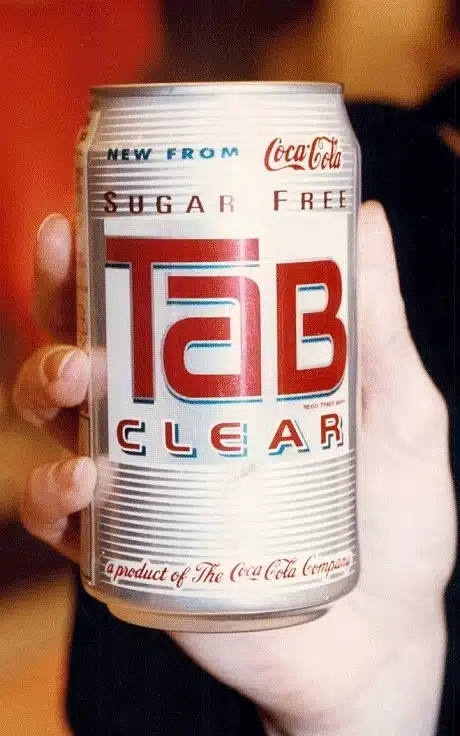
The setup: Tab and Tab Clear
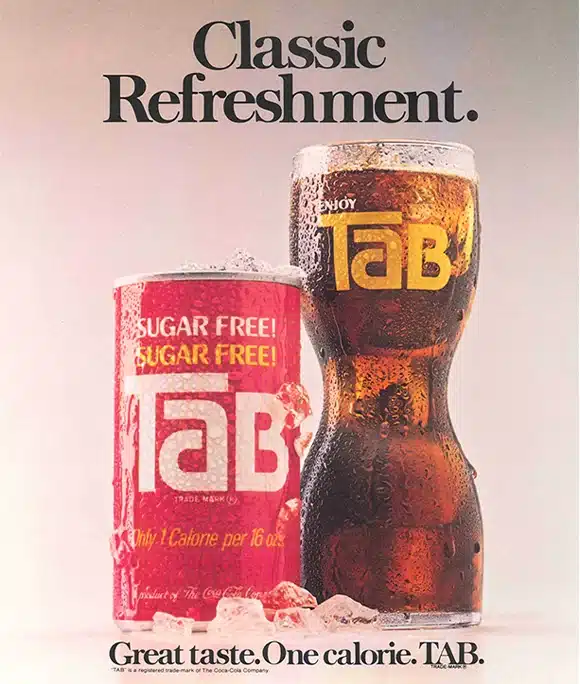
Coca-Cola picked the Tab brand on purpose. It was a sacrificial pawn. Tab was a diet cola that had peaked in the 1980s and faded to a mere 1% of Coke’s market share by the early ’90s.
The largely popular Diet Coke had taken over, so Coke could afford to throw Tab under the bus. If Tab Clear failed (as intended), it wouldn’t tarnish Coca-Cola’s core brand at all. But if by some chance Tab Clear caught on, that would be a bonus. It was a no-lose strategy.
They stripped the caramel color from regular Tab, kept it sugar-free and caffeine-free (or at least said so), and launched Tab Clear. In other words, the closest thing to Crystal Pepsi.
Tab Clear wasn’t meant to win. It was meant to confuse. In stores, Tab Clear were stocked next to Crystal Pepsi, implicitly linking them. The intended effect was classic repositioning- if Tab Clear = diet soda, and Tab Clear looks just like Crystal Pepsi, then Crystal Pepsi must be a diet soda too.
In the early ’90s diet sodas were viewed as “inferior” and niche products, and predominantly for women. By connecting Crystal Pepsi with a failing diet soda brand (Tab), and an unpopular category, Coca-Cola aimed to strip Crystal Pepsi of its mass appeal.

Full-on kamikaze
Coca-Cola didn’t just want to compete. They wanted to kill the category.
Tab Clear launched the same day Crystal Pepsi went national. It hit shelves in 10 major US cities. But they didn’t stop there. Coke pushed Tab Clear overseas fast. It launched in the U.K. in January 1993 and in Japan by March 1993.
Coca-Cola executed the Tab Clear gambit with minimal marketing investment, especially compared to Pepsi’s lavish campaign. PepsiCo spent around $40M promoting Crystal Pepsi in 1992–93, including expensive Super Bowl ads. Coke, meanwhile, kept things quiet. They ran a few ads in select cities, just enough to get Tab Clear noticed, but not enough to build a lasting brand.
Coke wanted to poison it. And it worked. Tab Clear launched in key cities just before Pepsi’s national Crystal Pepsi push. That meant store shelves already had a clear cola when Pepsi arrived with its big campaign.
Coca-Cola leveraged its strong distribution network to get Tab Clear on shelves nationwide by mid-1993. It didn’t matter if sales were weak. The goal wasn’t sales, it was sabotage. Just having Tab Clear next to Crystal Pepsi was a strategic win. Zyman called it a “kamikaze effort.” Internally, this was seen as a new kind of preemptive strike.
CEO Roberto Goizueta explained that Coke was testing a “throw ’em up and see if they stick” model - rapid product launches without attachment. They developed Tab Clear in just 2 months (compared to Pepsi’s 18) and were fine dumping it once the damage was done.
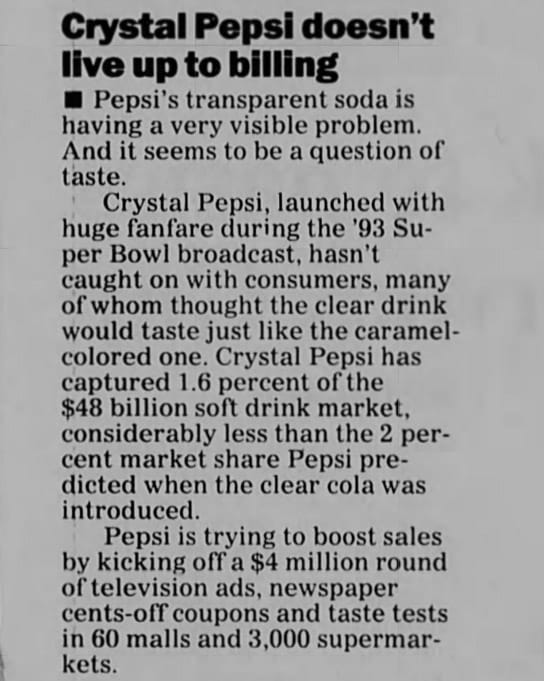
By mid-1994, Tab Clear was dead. Crystal Pepsi followed soon after. Even a short-lived product can win the war.
The end of the FAD
To make things worse for Pepsi Clear, after a while, product issues started to appear. The flavor, described as a lighter, less acidic Pepsi, didn’t wow consumers.
CMO David Novak later said it was “the best idea I ever had, and the worst executed.” Pepsi eventually tried to fix the taste with a citrusy reboot called “Crystal from Pepsi” in 1994, but it was too late. The clear soda trend was already dying.
Meanwhile, their attempt to position Crystal Pepsi as both healthy and full-flavor led to mixed messaging. Coke’s trap had worked. Pepsi’s marketing got muddled, and their brand extension quietly faded as they refocused on core products like Pepsi Max.
As Zyman mentioned "Pepsi spent an enormous amount of money on the brand and, regardless, we killed it. Both of them were dead within six months."
 Psychology
First-Mover Disadvantage (when you're too early) + Novelty effect
Crystal Pepsi launched a new category. But when you’re too early, it’s risky. People hadn’t formed strong emotional bonds with it yet, which made it fragile and easy to hijack.
Even though the novelty bias worked wonders at first, it faded quickly. Once the hype wears off, people evaluate the product on its real merits. If the taste is just okay... they bounce.
Cognitive Dissonance
People felt weird drinking something that looked like Sprite but tasted like Pepsi. Their senses clashed.
That mismatch caused discomfort, even if they couldn’t explain it.
So they avoided it altogether.
Law of Similarity + Law of Proximity + Categorization Bias
Here’s how your brain makes quick decisions at the store:
- If two products look the same and sit next to each other, your mind assumes they are the same.
- That’s the Law of Similarity (they look alike) and the Law of Proximity (they’re next to each other).
- Then comes Categorization Bias — your brain files both into a pre-existing mental folder.
In this case, people already had a folder labeled “diet soda” - something they didn’t really love, often tied to weak flavor or niche audiences.
So when Tab Clear showed up right beside Crystal Pepsi, looking nearly identical (same clear liquid, similar bottle), the brain shortcut kicked in: “They look the same, they must taste the same, and they must both be diet.”
And once that mental label stuck, people avoided Crystal Pepsi. Not because of what it actually was, but because of what it was grouped with.
Simplicity wins
Crystal Pepsi was just too complicated. Most people don’t want to analyze their soda. They want to grab, sip, and go. Pepsi tried to say a lot with Crystal Pepsi: it’s healthy, it’s cool, it’s innovative, it’s pure, it’s still Pepsi... but also not.
That’s just too much for a low-stakes decision like picking a drink. Your brain follows the path of least resistance. It wants a simple answer, not a layered message.
When in doubt, the brain defaults to what it already knows. And in this case, it knew “Brown Pepsi = good. This clear thing? I don’t get it. Skip.”
Coca-Cola didn’t overload the message. They planted a single idea “this is a weird diet knockoff”, and let that simple thought do all the damage.
 Window of Opportunity
Crystal Pepsi is a case of how being first and winning the launch doesn't mean your product will succed in the long run. It’s also a playbook on what happens when category creation meets confusion.
- Launching first is not always the advantage
Pepsi thought being first with a clear cola would win the market. But consumers didn’t have a frame of reference yet. With no emotional bond or category clarity, Crystal Pepsi was vulnerable to confusion and sabotage. Sometimes, it’s smarter to be second. - If your message isn’t simple, someone else will write it for you
Pepsi tried to say: this is pure, healthy, but also full-flavor Pepsi. That’s a lot. Coke gave people one message: “It’s diet soda.” In marketing, clarity always beats complexity. - Don’t fight on taste if people shop by shortcuts
In blind taste tests, Crystal Pepsi was fine. But real-world shoppers use visual and emotional shortcuts. Coke hijacked those shortcuts with Law of Similarity and Proximity. By placing Tab Clear next to Crystal Pepsi, the average shopper's brain lumped them together. Result? Both failed. - If you invent a new category, you must own the category
Pepsi didn’t just launch a product - they launched a category. But they didn’t protect it. Crystal Pepsi should’ve screamed its difference, created new shelf space, and defined new rules. Instead, it blended in, got mislabeled, and died. If you don’t control your category, your competitor will. - A single cognitive bias can collapse a $474M product
Consumers didn’t reject Crystal Pepsi based on logic. They rejected it based on mental shortcuts “it looks like a diet drink. I don’t like diet drinks.” That one thought, created by Tab Clear’s presence, undid all of Pepsi’s taste tests, branding, and marketing dollars. - You don’t need a better product - you need a better narrative
Pepsi had a better idea. Coke had a better story. In the end, that story killed the hype and crushed the category. Marketing is storytelling, and the simplest story often wins.
